



How to Find Professional Clothes That Fit You Properly
Table of Contents
- Why Professional Clothes Often Fail to Fit
- How to Measure Yourself for Clothes Before You Shop
- Understanding Business Attire Examples for Your Workplace
- How Should Work Clothes Fit? A Practical Checklist
- Choosing the Best Fabrics for Work Clothes
- When a Tailor Is Worth Using and How to Alter Pieces
- Trying On Your Next Workwear Piece With Confidence
- Frequently Asked Questions
Why Professional Clothes Often Fail to Fit
Sizing is the first problem. A UK size 12 in one brand can measure quite differently from a size 12 in another.
Cut is the second problem. Tailored pieces are built around structure. A blazer needs room across the back and a clean line over the bust.
Fabric is the third. Stiff or cheap cloth bags at the knees and creases at the elbows, which makes even a well-cut piece look tired by midday.
Finally, most people shop without knowing their measurements. Without them, you are guessing.
How to Measure Yourself for Clothes Before You Shop
Accurate measurements turn guesswork into a plan, and they are the foundation of how to find professional clothes that fit reliably across different brands. Most shoppers guess their size from memory or from the label of a garment that happens to fit, which is why so many workwear purchases end up unworn. Taking five minutes with a tape measure before you shop is the single highest-return habit you can build.
What You Need
Use a soft dressmaker's tape, not a metal builder's tape. Stand in front of a mirror so you can check the tape is level, and wear light underwear or close-fitting clothing. Ask someone to help with the back and shoulder measurements if you can, self-measuring the shoulder width accurately is difficult.
The Six Measurements That Matter
- Bust: around the fullest part, keeping the tape straight across the back and level under the arms. Do not pull tight; the tape should sit flat against the body.
- Waist: around the narrowest point, usually just above the navel. Breathe out normally before you read the number, do not hold your breath in.
- Hips: around the fullest part of the seat, feet together. Keep the tape level all the way round; it is easy to let it dip at the back.
- Shoulder width: from the edge of one shoulder bone to the other, across the back. This is the measurement most people get wrong, and it is the one that matters most for jackets.
- Sleeve length: from the shoulder point, down the arm, with the elbow slightly bent. Measure to the wrist bone, not the knuckle.
- Inside leg: from the crotch to the ankle bone, standing straight without shoes.
Write each number down and keep the note on your phone. Re-measure every six months or so, because bodies change and so do the cuts brands use.
Turning Measurements into a Size
Compare your figures with the size guide on each product page, not the size label alone. A UK size 12 in one brand can measure quite differently from a size 12 in another, because brands cut patterns to their own customers.
A common pattern is to find that your bust and hip measurements point to different sizes.
Watch out: measuring over bulky clothing or pulling the tape tight will give you numbers that are too small, and you will end up buying garments that feel restrictive across the back and shoulders.
Measuring for Specific Garments
For a jacket, the shoulder width and bust are the critical figures; a jacket that is right at the shoulder can be taken in at the waist, but one that is wrong at the shoulder is very hard to rescue. For trousers, the waist and inside leg matter most, with the hip measurement a close third.
If you shop online, keep a note of the measurements that worked for you in each brand. Over time this becomes more reliable than any size label.
The six measurements below are the ones to take before comparing size guides.
| Measurement | How to take it | Why it matters |
|---|---|---|
| Bust | Fullest part, tape flat and level | Core fit for tops and jackets |
| Waist | Narrowest point, breathe out normally | Sets trouser and skirt fit |
| Hips | Fullest part of the seat, feet together | Checks skirt and trouser fit |
| Shoulder width | Shoulder bone to shoulder bone across the back | Most critical for jackets |
| Sleeve length | Shoulder point to wrist bone, elbow slightly bent | Determines cuff position |
| Inside leg | Crotch to ankle bone, standing straight | Sets trouser length |
Understanding Business Attire Examples for Your Workplace
Business formal usually means a matching suit or tailored separates in dark, muted colours. Business casual allows softer fabrics, knitwear and trousers without a full jacket. Smart-casual is looser again, but still polished.
Your workplace sets the rules.
Good examples for most offices include a structured blazer over a button-up shirt, tailored trousers, a knee-length skirt, and a blouse with a clean neckline. These pieces mix well, so a small capsule can cover a full working week.
How Should Work Clothes Fit? A Practical Checklist
Work clothes should look smooth and feel comfortable. Use this checklist when you try pieces on.
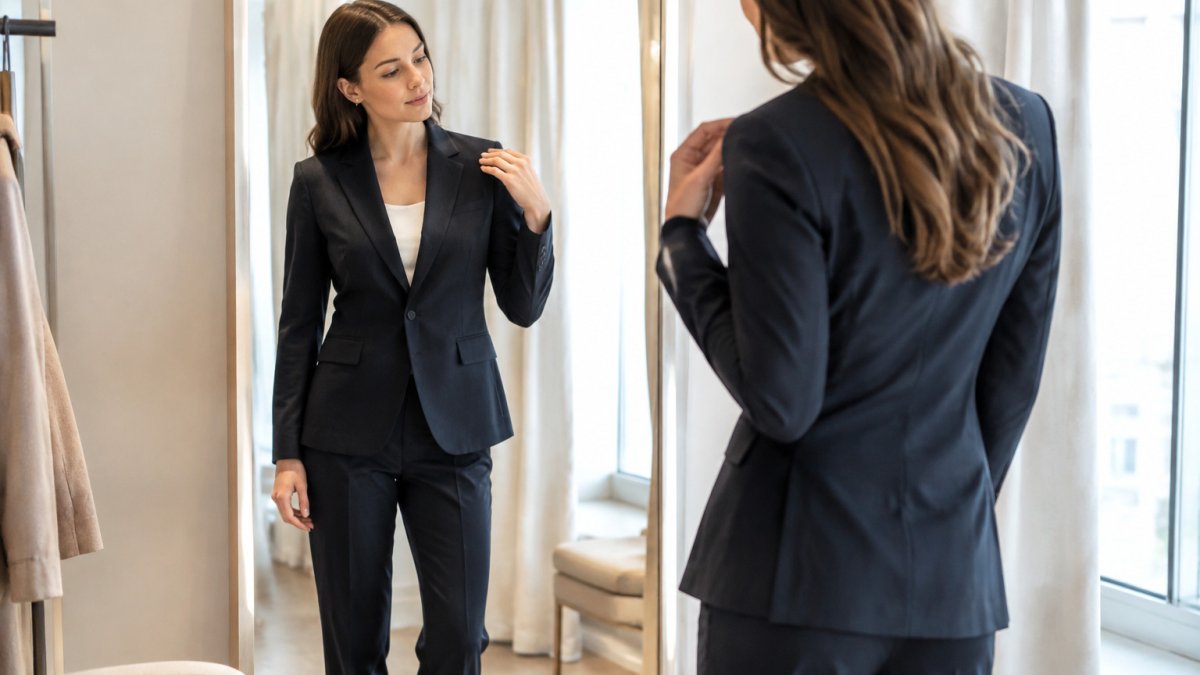
Shoulders, Jackets and Sleeve Length
The shoulder seam should sit at the edge of your shoulder bone. If it sits lower, the jacket will look oversized. Sleeves should end at the wrist bone so a little shirt cuff shows.
A close-fitting piece like the UK guidance on choosing workwear fit approach to office clothing is not a rule, but the principle holds: you should be able to sit, reach and type without strain.
Our Piping Detail Jacket is built with a feminine silhouette and a hidden hook and eye clasp at the waist, which helps you check how a tailored jacket should sit at the shoulders and sleeves.

Trousers, Skirts and Waist Fit
Trousers should sit at the natural waist without gaping at the back. The hem should just touch the shoe when you stand. For a skirt, check that it lies flat over the hips and does not pull when you sit down.
Our Smart Cigarette Trouser has a straight leg, a side zip and an elasticated band, so you can compare how a tailored trouser holds its shape at the waist. For a wider range of silhouettes, see our Skirt With Pockets: 2026 Styles for Work and Occasions guide.

Choosing the Best Fabrics for Work Clothes
Fabric decides how clothes behave through a long day. Look for a blend that holds its shape and resists creasing. Some of our pieces use a polyester and elastane mix, which keeps a clean line and allows movement.
- Natural fibres such as wool breathe well but can need more careful care.
- Synthetic blends hold their shape and are easier to wash.
- A small amount of elastane gives movement without sagging at the knees.
Our Blouse with pleat front is made from a fabric with a snug fit, so if you want a looser look, size up.
When a Tailor Is Worth Using and How to Alter Pieces
A tailor is worth using when a garment fits well in most places but needs a small change. The skill is knowing which alterations are straightforward, which are risky, and which mean you should walk away from the purchase.
Alterations That Are Usually Straightforward
- Taking in or letting out a waist: common on trousers and skirts, and usually a simple job if there is enough seam allowance. Check inside the garment for spare fabric before you buy.
- Shortening a sleeve: straightforward on an unlined sleeve or one with a simple cuff. On a lined jacket sleeve with working buttonholes, the job is more involved and costs more.
- Hemming trousers or a skirt: one of the cheapest alterations and one of the most transformative for how a garment looks.
- Taking in a side seam: a clean way to refine the fit through the body without touching the shoulders.
Alterations That Are Risky or Expensive
- Shoulders: the hardest part of a jacket to change. Taking in or letting out shoulders disturbs the structure of the garment and can cost more than the jacket is worth. Buy for the shoulder and alter elsewhere.
- Resizing a garment by more than one size: major changes to a jacket can cost more than the garment is worth and rarely look right.
- Working buttonholes on a sleeve: shortening past the last buttonhole is not possible without rebuilding the cuff.
What Alterations Cost
Costs vary by the complexity of the job. Ask for a quote before you commit, and compare it with the price of the garment. A common pattern is for shoppers to spend a meaningful fraction of the purchase price on alterations without factoring it in at the till.
A Decision Framework Before You Buy
Ask three questions before buying a piece that needs work:
- Does it fit at the shoulder and bust (for jackets) or at the hip (for trousers and skirts)? If yes, the rest is usually alterable.
- Is there enough seam allowance to let the garment out if needed? Check the inside seams.
- Does the alteration cost make sense against the price of the garment? If the alteration is a large share of the price, you may be better off finding a better-fitting piece.
Avoid buying a size too large and hoping to take it in. Keep the receipt and ask about alteration costs before you buy, not after.
Finding a Tailor
Look for a tailor who regularly works with the type of garment you are altering. Ask to see examples of their work, and start with a low-cost alteration such as a hem before trusting them with a jacket.
Our Piping Detail Jacket is cut with a defined waist and a centre back length of 59.5 cm, which gives you a clear reference point for how a tailored jacket should sit before you decide whether an alteration is needed.
Trying On Your Next Workwear Piece With Confidence
Try clothes on in the same underwear and shoes you would wear to work, and move as you would during a normal day. Sit, reach and raise your arms. If anything pulls or gapes, it will bother you later.
Once you have a fit you trust, keep the garment care in mind. Our How to Maintain Crease Resistant Workwear: 2026 Guide explains how to keep your pieces looking their best between wears.
Ready to find your fit? Explore our luxury womenswear collection and check each product's measurements against your own.
Frequently Asked Questions
How should professional clothes fit?
Professional clothes should sit smoothly across the shoulders with the seam landing at the edge of the shoulder bone, without pulling or gaping across the bust. Jacket sleeves should end around the wrist bone so a small amount of shirt cuff shows. Trousers should skim the hips without digging in, sit at the natural waist, and break lightly over the shoe. Fabric should lie flat without tugging, and you should be able to sit, reach and move without the garment shifting out of place. If you can pinch more than a finger's width of fabric at the waist or back, size down or ask a tailor about taking it in.
How do I find work clothes that fit my body shape?
Start by identifying the areas that most often need adjusting for your shape, such as the bust, waist, hips or shoulders, rather than choosing by size alone. Brands cut their patterns differently, so check size charts against your own measurements and read the model's height and size details on each listing. Pieces with structured shoulders can suit a narrow frame, while A-line skirts and bootleg trousers often balance a fuller hip or lower body. Keep a note of which brands and cuts have fitted you well and return to them when shopping.
How do I measure myself for work clothes?
Use a soft measuring tape and measure over your underwear or fitted clothing. Take the bust at its fullest point, the waist at the narrowest point, and the hips at the widest point around the seat, keeping the tape level. Measure shoulder width from the edge of one shoulder bone to the other, and inside leg from the crotch to the ankle bone. Write the figures down and compare them with the brand's size chart in centimetres, as sizing varies between labels.
Are tailoring and alterations worth the cost for work clothes?
Alterations are often worth it for pieces you wear regularly, such as a blazer or a pair of tailored trousers, because a small change to the sleeve length, hem or waist can make an off-the-peg item look bespoke. Simple hemming is usually the least expensive adjustment, while taking in a jacket is more involved. Ask a tailor to assess the fit before changing anything, and avoid spending heavily on a garment whose shoulders or overall cut do not already suit you.
