



Is It True That 85% of All Textiles Go to Dumps Each Year?
Last Updated: 25 October 2026
Quick Summary
Is it true that 85% of all textiles go to dumps each year? No, the claim is a distortion rather than a fact, tracing back to a 2017 Ellen MacArthur Foundation report about clothing value lost to landfill or incineration. The original estimate never counted every textile globally and excluded clothing that is reused, resold, exported or recycled.
- The 85% figure traces to a widely shared Ellen MacArthur Foundation report from 2017.
- The original estimate described underused or discarded clothing in high-consumption economies, not all textiles everywhere.
- The figure conflated landfill with incineration, which recovers energy, and excluded reused, resold and recycled clothing.
- Sorting clothes before donation keeps usable garments in circulation and stops worn items spoiling recycling batches.
- Before buying, ask whether you will wear an item at least thirty times and whether it survives the wash cycle.
Table of Contents
- Where the 85% Textile Waste Statistic Actually Comes From
- Textile Waste Statistics That Give the Fuller Picture
- How to Recycle Clothes Without Sending Them to Landfill
- Sustainable Fabrics: What the Material Actually Tells You
- How to Reduce Clothing Waste Before You Buy
- What Happens to Clothes After You Donate Them
- Build a Wardrobe That Keeps Clothes Out of the Waste Stream
- Frequently Asked Questions
Where the 85% Textile Waste Statistic Actually Comes From
Is it true that 85% of all textiles go to dumps each year? The claim is a distortion, not a fact. The figure traces back to a widely shared Ellen MacArthur Foundation report from 2017, which estimated that a quantity of clothing worth around $500 billion is lost to landfill or incineration annually, largely because garments are worn for far shorter periods than they once were. Somewhere between that report and the social media posts that followed, a nuanced estimate about lost value and underuse hardened into a blunt percentage applied to every textile on earth. This guide from HotSquash examines where the number came from, what it really measures, and what a more accurate picture of textile waste looks like.
What the Figure Counts (and What It Leaves Out)
The original estimate was never a tally of every garment, curtain and bedsheet produced globally. It described the share of clothing that is underused or discarded within a year in high-consumption economies, not the fate of all textiles everywhere. It also conflated two very different destinations: landfill and incineration. Incineration recovers energy; landfill does not. And the figure excluded the substantial volume of clothing that is reused, resold, exported or recycled through charity and commercial channels. Treat the 85% claim as a rough signal of overproduction, not a precise measurement.
Why the Number Gets Repeated So Often
Simple, alarming numbers travel further than careful ones. The 85% figure fits neatly into a headline and a social post, and once a statistic is repeated enough times it takes on the appearance of settled fact. The problem is that repetition is not verification. A statistic that cannot be traced to a current, transparent source should be treated as a prompt to investigate rather than a conclusion.
Textile Waste Statistics That Give the Fuller Picture
Reliable textile waste statistics are harder to pin down than a single viral number, but the broad direction is consistent. Public bodies and industry researchers generally agree that clothing consumption has risen sharply over recent decades while the average number of times a garment is worn has fallen. That combination, more clothing bought and each piece worn less, drives waste regardless of the exact percentage. Many sustainability analysts argue the more useful metric is not how much is dumped but how quickly garments move from purchase to discard. A wardrobe built around fewer, longer-lasting pieces changes that trajectory directly.
How to Recycle Clothes Without Sending Them to Landfill
Recycling clothes properly means matching each item to the right route: resale, donation, textile recycling or take-back. The mistake most people make is treating the clothing bank as a bin for anything fabric. Sorting first is what keeps usable garments in circulation and stops contaminated or worn-out items from spoiling a recycling batch.
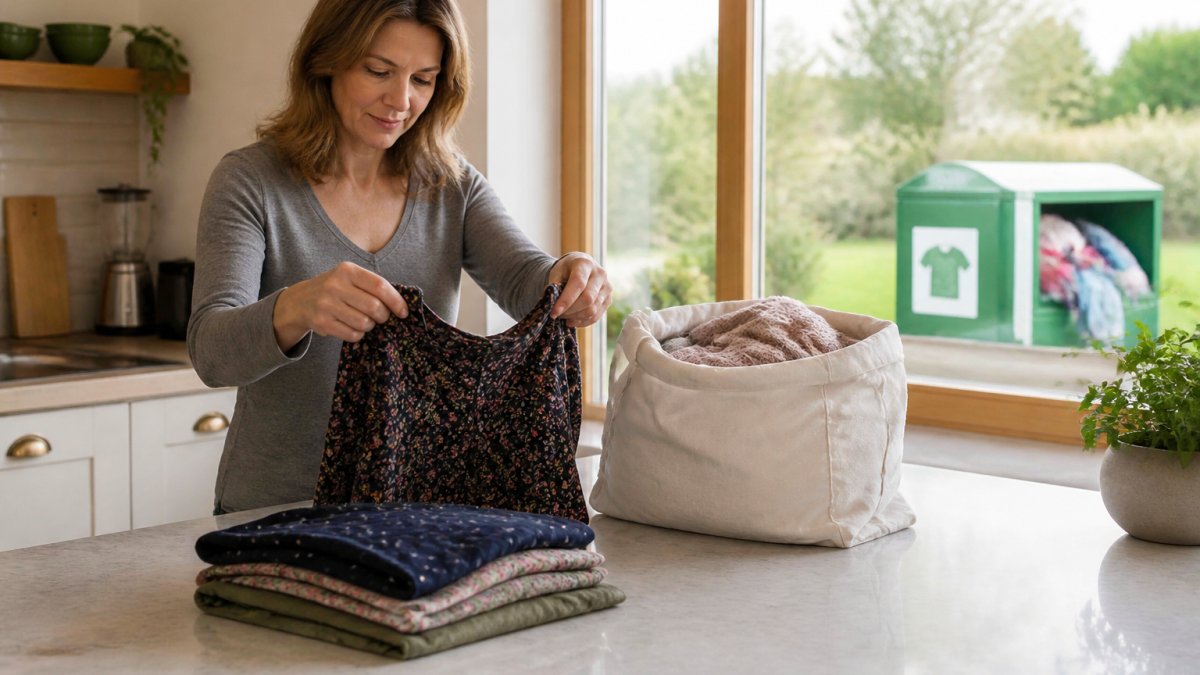
Start with a simple triage:
- Good condition, current style: charity shop, resale app or a friend
- Worn but clean: textile recycling bank or kerbside collection
- Stained, torn or single shoes: recycling, never the charity bag
- Brand take-back schemes: many retailers accept their own garments for recycling
Charity Shops, Kerbside Collections and Take-Back Schemes
Charity shops remain the most accessible route for wearable clothing, and most local councils now run kerbside textile collections or provide recycling bank locations. Retailer take-back schemes are growing too, letting you return worn items in-store. Watch out: donating unsellable, dirty or wet clothing costs charities money in disposal fees, so only pass on items you would be happy to see on a rail. If you want to avoid landfill altogether, sustainable alternatives to fast fashion jumpsuits show how to replace disposable pieces rather than simply discard them.
Sorting each item to the right route is what keeps usable clothing in circulation.
| Item condition | Where it should go |
|---|---|
| Good condition, current style | Charity shop, resale app or a friend |
| Worn but clean | Textile recycling bank or kerbside collection |
| Stained, torn or single shoes | Recycling, never the charity bag |
| Brand garments | Retailer take-back schemes |
Sustainable Fabrics: What the Material Actually Tells You
A fabric label tells you more about a garment's environmental impact than any marketing claim on the swing tag. Natural fibres such as linen, organic cotton and wool are generally biodegradable, but their footprint depends on how they were grown and processed. Synthetic fabrics like polyester are durable and crease-resistant yet shed microplastics when washed. The honest answer is that no fibre is perfect; longevity matters more than the label alone. A well-made garment worn for years outperforms a "green" one worn twice. For a broader look at how material choices fit together, our guide to ethical clothing and sustainable fashion puts fabric claims in context.
How to Reduce Clothing Waste Before You Buy
The most effective way to cut clothing waste is to buy less and choose better. Before any purchase, ask three questions: will I wear this at least thirty times, does it work with what I already own, and will it survive the wash cycle? A common mistake is buying for a single occasion and then discovering the piece has no second life. Cost-per-wear is a useful mental check: a versatile dress worn regularly beats a trend piece worn once, whatever the price tag. Our article on how to identify ethical fashion labels explains the certifications and language that separate genuine claims from greenwashing.
What Happens to Clothes After You Donate Them
Donated clothing does not simply vanish into a good cause. Charity shops sell what they can locally; the remainder is often sold on to textile merchants who sort it for resale, recycling or, in some cases, export. The best outcome is a garment that finds a new owner and stays in use. The worst is an item too degraded to sell that ends up in waste anyway. This is why condition matters so much at the point of donation, and why buying durable clothing in the first place is the real lever.
Build a Wardrobe That Keeps Clothes Out of the Waste Stream
A low-waste wardrobe is built deliberately, not decluttered into existence. The principle is fewer, better pieces that work together and last. Prioritise fabrics that resist creasing and hold their shape, choose timeless cuts over trend-led ones, and repair before you replace. If you are weighing whether to invest more per piece, it helps to know whether premium sustainable fashion is worth it, and for occasion dressing, our eco-friendly evening wear buying guide shows how to choose pieces that earn their place for years rather than a single event.
A practical starting checklist:
- Audit what you already wear most and why
- Identify gaps rather than duplicates
- Check fabric, construction and care instructions before buying
- Set a cost-per-wear target for every purchase
- Repair, alter and rewear before discarding
Choosing well-made, versatile clothing is the simplest way to keep textiles in use and out of the waste stream. At HotSquash, we design and produce luxury womenswear in London with a low carbon footprint, using premium fabrics and crease-resistant finishes so each piece works harder in your wardrobe. With free UK delivery and free UK returns, trying a more considered approach is straightforward. Start Shopping.
Frequently Asked Questions
Is it true that 85% of textiles end up in landfill each year?
The 85% figure is widely repeated but it is a global estimate, not a precise annual measurement, and it is often misquoted. It generally refers to the share of all textiles produced that end up dumped or burned rather than reused or recycled, across the whole world. The real figure varies by country and by how the data is counted. Treat 85% as a rough headline rather than a fixed fact, and check the specific textile waste statistics behind any claim before repeating it.
Where does the 85% textile waste statistic come from?
The number is usually traced to international circular-economy research that estimated only a small share of clothing is collected for reuse or recycling, with the rest going to landfill, incineration or being dumped. It is a modelled global estimate covering all textiles, not just clothing, and it is several years old. Because it is a model rather than a direct count, the exact percentage shifts depending on the source and the year. It is best used to illustrate the scale of the problem, not as a precise annual figure.
Can textiles be recycled in the UK?
Yes, but not through standard household recycling bins. Most councils do not collect clothing and textiles kerbside as part of general recycling. Instead you can use textile banks at household waste and recycling centres, charity shop collections, retailer take-back schemes and some local kerbside textile collections where offered. Items in good condition are usually resold or sent for reuse, while worn-out fabric can be recycled into insulation, cleaning cloths or stuffing. Check with your local council for what is accepted in your area.
How can I reduce clothing waste at home?
Start by buying fewer, better-made pieces you will wear repeatedly, and repair small faults like loose buttons or hems before discarding anything. Wash garments less often and at lower temperatures to extend their life, and store them properly to avoid damage. When you no longer want something, pass it on through charity shops, resale apps or clothing swaps rather than binning it. Choosing sustainable fabrics and pieces designed to last, rather than fast-fashion trends, makes the biggest difference over time.
